
Fire in the Blue zone!
Will a narrow escape from all-consuming flames at the COP30 be a eureka moment for the climate summit? The answer is no

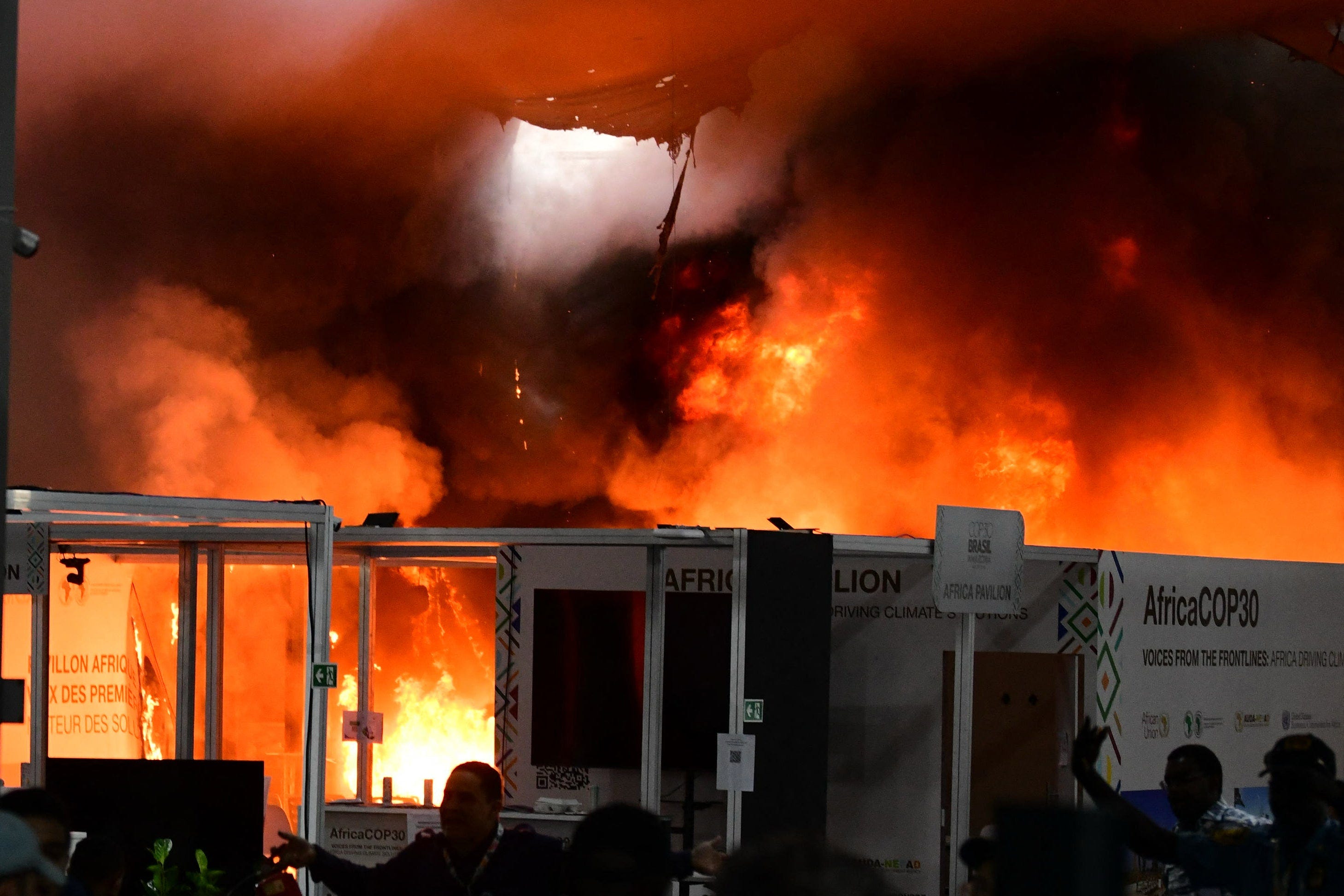
‘All accredited COP participants can now access the COP30 venue as usual,’ announced the event organisers after a fire in the Blue Zone caused panic on Thursday. And, indeed, it was business as usual on Friday at the epic climate conference staged at the mouth of the Amazon in the Brazilian city of Belém for the last day of the two-week summit.
Environment ministers from nearly 200 countries, along with bigwigs such as Brazilian President Luiz Inácio Lula da Silva and UN Secretary-General António Guterres, engaged in a frantic round of negotiations centered on the measures needed to reduce CO₂ emissions and help developing countries finance the energy transition.
Yet although the fire was extinguished in a matter of minutes and no one was injured except for a dozen attendees who suffered monetary respiratory problems from smoke inhalation, the chilling thought of what might have happened remained. Especially for those delegates, politicians, officials, and journalists—who discussing climate justice in the East African countries saw flames devour the plastic walls behind their pavillion . Only the rapid response by some summit participants who bravely grabbed fire extinguishers and put out the flames, soon followed by the mainly female fire brigade, prevented a disaster that would have entered the history books as an act of nature’s vengeance.
“It was a close run thing” , noted a COP30 brief, pausing for a moment of thought from the daily updates on LMDCs, HACs and MRvs, the COP30 diet of unfathomable acronyms. Would the fright shift perceptions, one wondered , a eureka moment where the world’s leaders -minus Trump’s USA- might realize how close a run thing the climate crisis already is? The answer,it soon became clear, is no. The draft for the Belem summits proposals was underwhelming and the combative Colombian Environment minister Irene Velez called a meeting to protest lack of ambition on the elusive fossil fuel phase out.
The fire too seemed a case of a disaster waiting to happen. Suspicions that many participants had expressed about the safety of a building which resembles a giant marquee were confirmed. The Brazilian Tourism Minister Celso Sabino, who I interviewed as I was fleeing the building, denied there were any problems with the safety of the facilities. But the risk of fire was easy to imagine for those who had glanced up at the ceiling of the Hangar, made of plastified canvas, over a structure assembled in just six months to accommodate the 60,000 participants in the event.
The fire authorities cited electrical failure due to power overload as the most likely cause. ‘Thousands of people used adapters, which increased the risk of a short circuit,’ said a firefighter, quoted in the local newspaper O Liberal.
If this raised doubts about the summit’s electrical infrastructure, what may raise more questions for the Brazilian government and authorities in the state of Pará were comments by the fire service about the high flammability of the materials used in the construction of the Hangar, built by Brazilian construction company DMDL, which specialises in temporary infrastructure and designed structures for the 2016 Olympic Games.
According to the firefighter, the plastic tarpaulins and decorations were highly flammable. They gave off toxic smoke due to the burning of materials made of foam, wiring, canvas and plastic components. The decorations installed to adorn the pavilions ‘contributed greatly to the rapid spread of the flames,’ she said.
During the first week of the summit, all media attention focused on the security problems caused when an indigenous demonstration broke into the Blue Zone. But the logistical risks of the complex were already obvious to all participants.
UNFCCC Executive Secretary Simon Stiell had signed a document in the first week of the summit demanding that protection be reinforced and problems such as flooding and high temperatures, resolved.
Journalists in the press room had already joked before the fire that the Hangar was the ideal setting for a summit aimed at preventing climate catastrophe.
The canvas roof became a sounding board for the thunderous tropical downpours that occur every afternoon in this city at the mouth of the Amazon making verbal communication impossible even in high powered meetings convened to discuss carbon emissions controls .. On Tuesday, thunder bolts added to the cacophony caused by the rain the perfect soundtrack for the summit at the end of the world.
In the press room, even the sturdiest of reporters, just back from reporting on the Munduruku indians in their fight against the Comando Vermelho drug gangs who now run illegal gold mines in the jungle, refused to set up their bureaus on some of the desk due pools of water close to the laptop. Small holes had appeared in the roof through which a the rain dropped sometimes on vital drafts of the final UNFCC resolution which would be exclusive news. Yet those who sought refuge in the dry areas at the back of the room had to contend with an icy wind and the deafening roar of the hastily installed air conditioning units.
There was occasional murmuring among the journalists, but this is a climate summit and most resigned themselves to face the forces of nature in the Amazon in solidarity with those most vulnerable countries (MVCs) in the global south. Few wished to vindicate German Foreign Minister Friedrich Merz, who, with European arrogance, had boasted of how grateful he was to be leaving Belém to return to Germany.
The stoicism in the press room turned to panic, however, on Thursday afternoon when the word ‘Fire!’ rang out in 20 different languages. The evacuation began and everyone fled from the Hangar to assemble in the back courtyard and proceeded to interview each other. “Why is there no smell of smoke? Are you sure this is a fire not a bomb?”. The wait in the tropical heat was just about tolerable, but not having a live video to post on social networks sent waves of panic through the reporters psyches. Many headed back to the hangar in search of the latest news. There they encountered the forcefulness of the standard Brazilian evacuation procedure. A barrier of security guards advanced along the corridor to force all remained in the building to leave. Some intrepid journalists insisted on filming the operation, walking backwards to capture on film the determined gestures of the advancing guards. Some tripped and fell to the ground. Recalling the forest fires that have ravaged the Brazilian Amazon in previous years, especially in the devastated state of Pará, even those reporters, specialized in carbon trading credits (CTCs) and mitigation mechanism (MMs) cpunld see the metaphor.